For many people leaving high-control religion, an unexpected difficulty one might face is the loss of a spiritual vocabulary. Years inside an authoritarian tradition can leave you fluent in a language of sin, fear, and unworthiness, and when you walk away from it, you may grasp to find words for wonder, for mystery, or for the sacred seasons you still feel deep in your bones. Reconstructing a spiritual identity after religious trauma is slow work, and it asks for rituals that can hold both grief and hope at the same time.
Samhain, (pronounced SAH-win) the ancient festival that sits at the root of Halloween, offers exactly that. As the Wheel of the Year turns toward the long nights, Samhain invites us to stop fearing the darkness and to enter it instead, deliberately and gently, as a place of healing, memory, and growth.
What religious trauma actually is
Religious trauma is a real and increasingly studied phenomenon. Psychologist Marlene Winell coined the term "religious trauma syndrome" in 2011 to describe the fear, shame, loss of agency, and fractured sense of self that can follow immersion in authoritarian religious environments (Winell, 2011). A systematic literature review published in Mental Health, Religion & Culture found consistent reports across studies of profound psychological and relational effects on people leaving harmful or coercive faith communities (Gillieatt et al., 2023). Researchers increasingly link this harm not to religion as a whole, but to the interpretation and enforcement of doctrine through fear, control, and shame.
Recovery from spiritual abuse is possible, and it follows a recognizable arc. A 2024 scoping review in Religions found that survivors often move through meaning-making and can even experience post-traumatic growth, becoming more authentic, more compassionate, and more self-directed than before (Perry, 2024). Clinicians and former practitioners describe this work as reconstructing the self that the high-control environment dismantled, choosing new beliefs and practices with open eyes rather than inheriting them through fear (Anderson, 2023).
The problem with "darkness"
If you grew up hearing that darkness means sin, ignorance, evil, or the devil's territory, that was a teaching, not a fact of nature. Scholars of religion note that the pairing of light with goodness and darkness with evil is a constructed metaphor with a long history in Western religious traditions, one that has shaped not only theology but the modern study of religion itself (Stolow & Meyer, 2021). Psychological research confirms how deeply this association runs: light and dark are processed as perceptual symbols of moral purity and pollution, so a child repeatedly told that night symbolizes wickedness carries that wiring into adulthood (Sherman & Clore, 2009).
Here is why this matters for healing. If darkness is coded as evil, then everything associated with it becomes forbidden: rest, shadow, endings, grief, the unconscious, the aging body, the ancestors, the unknown. A person recovering from religious trauma often finds that their pain, their doubts, and their anger have all been labeled "dark" and therefore shameful. Healing is interrupted when half of your inner life is banished.
The depth psychologist Carl Jung called the disowned parts of ourselves the shadow, and argued that what we refuse to acknowledge consciously continues to shape us unconsciously (Jung, 1959). Shadow work, the practice of meeting those rejected parts with curiosity instead of condemnation, has become a cornerstone of modern healing precisely because so many of us were taught to be afraid of our own depths. Seasonal spirituality gives that work a natural home.
Samhain: a different story about the dark
Samhain marks the end of the harvest and the beginning of winter in the old Celtic calendar, falling around October 31 to November 1. Historian Ronald Hutton's landmark study of the ritual year traces how this festival of the dead and the turning of the season survived centuries of change, merging with the Christian feasts of All Saints and All Souls and eventually feeding into the Halloween we know today (Hutton, 1996). Cultural historian Nicholas Rogers documents how the night's traditions, from costumes to divination, grew out of folk practices for navigating a time of year when the boundary between the living and the dead felt thin (Rogers, 2002).
Strip away the pop-culture veneer and notice what Samhain actually says about darkness: it is not the enemy. It is the season. The year is not defeated by the coming winter; it is resting, composting, gathering strength. The festival treats the dark months as a time to honor ancestors, release what the old year carried, and prepare soil that will bloom in spring.
That is a complete reversal of the theology of darkness many survivors grew up under. In Samhain's frame:
Darkness is where rest happens, not where punishment waits.
Grief is an act of love, not a lack of faith.
The ancestors are welcomed, not feared.
Endings are honored as part of the cycle, not treated as spiritual failure.
How Samhain supports identity reconstruction
Reconstructing a spiritual identity after religious trauma means learning to trust your own experience again, and Samhain offers three practices that map beautifully onto that work.
Honoring grief as sacred. People leaving high-control religion often need to grieve the community, the certainty, and even the god they were told to love. A simple Samhain ritual, writing down what you are releasing and letting it go, gives that grief a container and a dignity the old framework never offered.
Meeting your ancestors on your own terms. For many survivors, especially those from traditions that weaponized ideas of the dead, the first safe place to re-enter the sacred is an ancestor altar. You choose who belongs there. You set the terms. That act of authorship is itself identity reconstruction.
Practicing shadow work with a seasonal rhythm. The dark half of the year provides a natural calendar for tending the inner work Jung described. Instead of fearing your doubts, anger, and old wounds, you can visit them the way Samhain visits the graves of loved ones: with respect, with patience, with trust that spring will come.
An invitation into the season
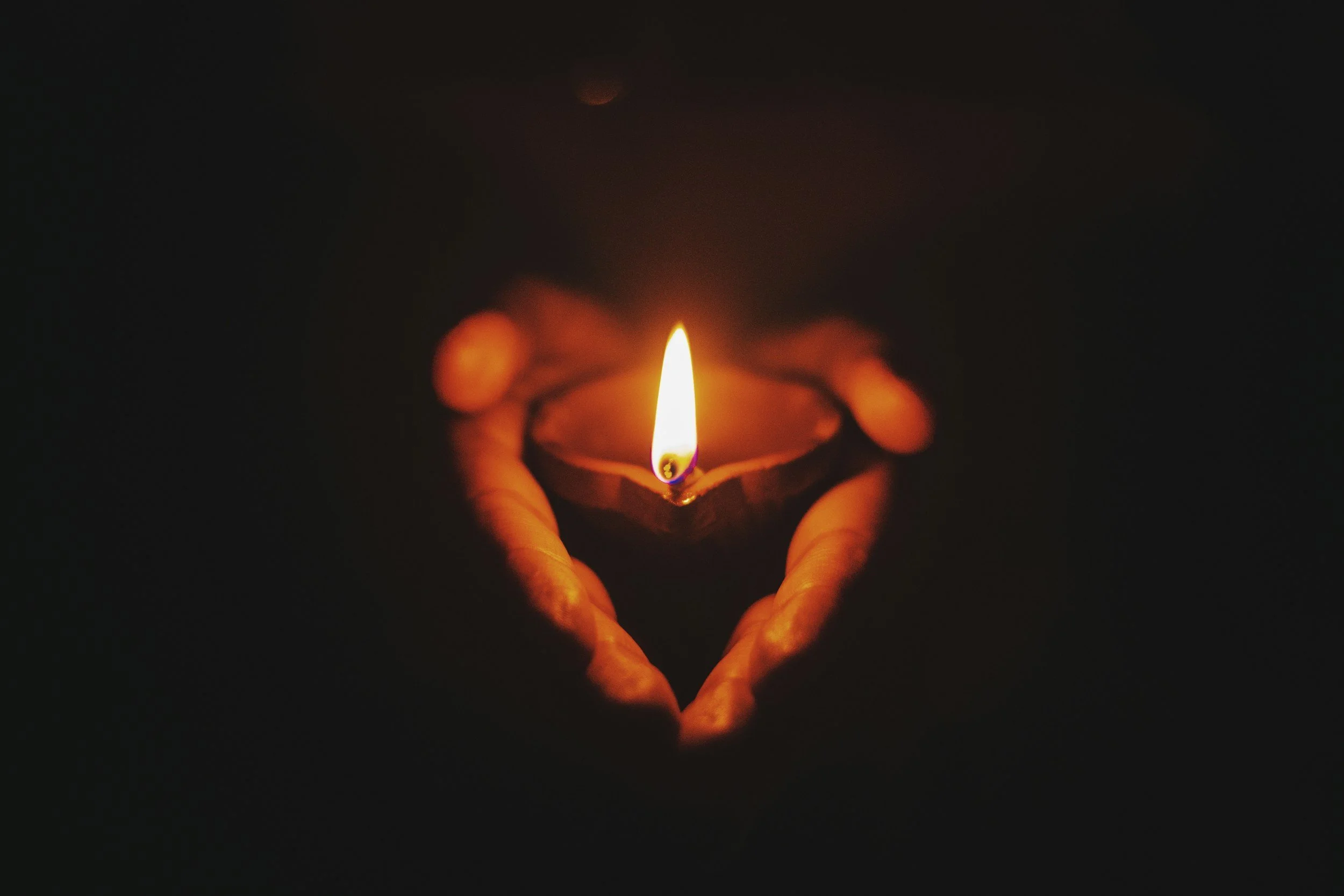
If you are rebuilding after religious trauma, you do not have to adopt an entire tradition to borrow Samhain's wisdom. Light a candle for someone you have lost. Sit in a dark room and let it be quiet instead of frightening. Write down what this year asked you to release. The point is not to perform a perfect ritual. The point is to experience, in your body, that the darkness can safely hold you.
Healing from religious trauma rarely happens all at once. It happens in seasons. And the season that begins at Samhain teaches the lesson survivors most need to learn: the dark is not the opposite of the sacred. It is one of its oldest homes.
If this resonates for you, even a little, reach out to schedule a free consultation and learn how our work together can help you develop seasonal rituals that rebuild self-trust and connection to your authentic spirituality.
References
Anderson, L. E. (2023). When religion hurts you: Healing from religious trauma and the impact of high-control religion. Brazos Press.
Gillieatt, S., Ullman, C., & Sanderson, J. (2023). Religious trauma: A systematic literature review. Mental Health, Religion & Culture, 26(3).
Hutton, R. (1996). The stations of the sun: A history of the ritual year in Britain. Oxford University Press.
Jung, C. G. (1959). Aion: Researches into the phenomenology of the self (R. F. C. Hull, Trans.; 2nd ed., Vol. 9, Pt. 2 of The collected works of C. G. Jung). Princeton University Press.
Perry, S. (2024). Religious/spiritual abuse, meaning-making, and posttraumatic growth. Religions, 15(7), Article 824. https://doi.org/10.3390/rel15070824
Rogers, N. (2002). Halloween: From pagan ritual to party night. Oxford University Press.
Sherman, G. D., & Clore, G. L. (2009). The color of sin: White and black are perceptual symbols of moral purity and pollution. Journal of Personality and Social Psychology, 96(5), 1015–1025.
Stolow, J., & Meyer, B. (2021). Enlightening religion: Light and darkness in religious knowledge and knowledge about religion. Critical Research on Religion, 9(2), 119–125. https://doi.org/10.1177/20503032211015276
Winell, M. (2011). Religious trauma syndrome [Series of three articles]. Cognitive Behavioural Therapy Today, 39(2)–(4).